
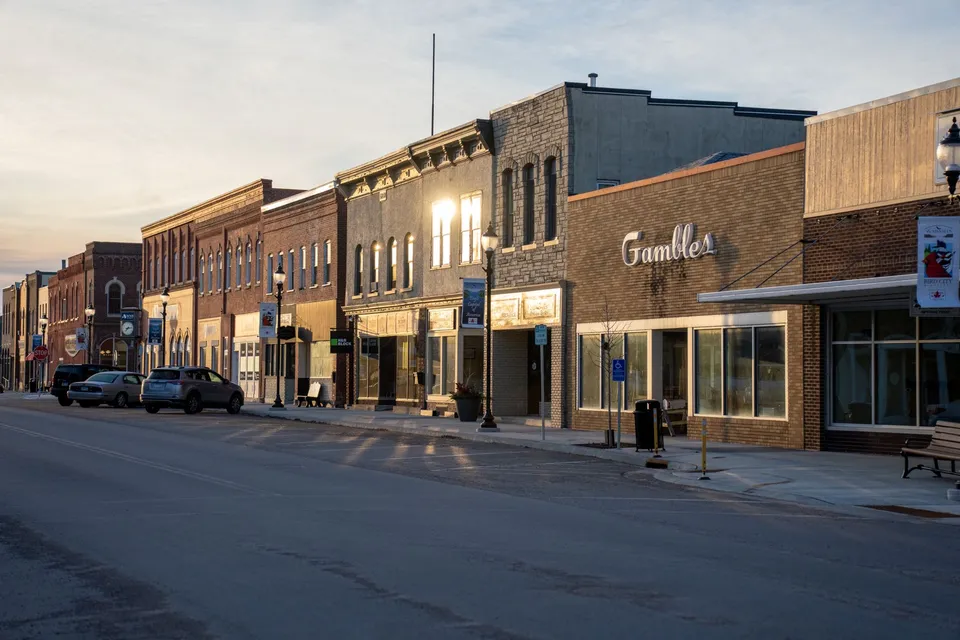
Morning in Brainerd starts with movement, not miles
A lot of places talk about being a “hub,” but Brainerd earns the label in a quieter way: by making ordinary trips easier to stitch together. In a city of about 14,400 people, surrounded by a county of 66,123 and closely tied to Baxter, the real story is not one big downtown moment. It is the chain of small crossings that gets people from home to work, class, appointments, and back again.
That chain begins with transit. Brainerd & Crow Wing Public Transit runs Monday through Friday from 6:00 a.m. to 6:00 p.m., with dispatch available during the day and an A.I. dispatcher outside regular dispatch hours. The service is not a niche option; it is a general public dial-a-ride system that reaches Brainerd, Baxter, Crosby, Pequot Lakes, and the Pine River area of Cass County. In other words, Brainerd’s “local” travel is already regional by design.
The city’s quiet workhorse is utility service
If transit is how people move, utilities are how the city keeps moving. Brainerd Public Utilities says it provides electric, water, and sewer service, serving Brainerd, parts of Baxter, and surrounding townships. Its audited statements go even further, noting that it provides electric distribution to portions of Baxter and treats 100% of Baxter’s wastewater. That kind of shared infrastructure is easy to overlook until it fails; then it becomes the only story that matters.
Brainerd Public Utilities also gives the city a sense of continuity. It says its roots go back to 1892, which means the current system is part of a long local habit: solve the practical problem first, then keep improving the network that supports daily life. In a place where weather, growth, and seasonal swings all matter, that long memory counts.
Work, school, and errands overlap more than people think
Brainerd’s economy is not built around one employer or one industry. Census QuickFacts shows substantial health care and social assistance receipts, retail sales, and transportation and warehousing activity, which is another sign that the city works as a service center for a broader area. It is also a place where commuting flows both ways: Crow Wing County’s 2015 inflow-outflow data showed thousands of people living outside the county but working inside it, and thousands more living in the county but working elsewhere. That is not a contradiction. It is the normal pattern of a regional labor market.
Education fits into that same pattern. Central Lakes College lists programs, tuition, and course information for students who need a credential without leaving the region. Its published 2025–2026 estimate of $220 per credit gives local families a concrete planning number, and its program catalog shows how students can move into transfer or career pathways without treating college as a one-size-fits-all step.
Brainerd’s practical geography reaches farther than city lines
The Brainerd Lakes Regional Airport is another reminder that “small-town” does not mean isolated. MnDOT’s airport directory identifies BRD as a local access point and explicitly lists Brainerd & Crow Wing Transit among the ground-transport options. That matters because air travel, taxis, rentals, and local transit all feed the same regional rhythm. Even people who never board a plane still feel the airport’s presence through visitors, business travel, and the economy around it.
Housing numbers also help explain the pace of life here. Brainerd’s median gross rent is lower than Baxter’s, and the two cities show different housing value profiles. Those differences suggest distinct housing stock, different development patterns, and different pressures on renters and owners. In practical terms, they help explain why people often shop, work, and study across municipal borders even when they sleep in one place.
The Brainerd advantage is familiarity
Brainerd’s strength is not that everything happens in one place. It is that the important parts are connected well enough to feel familiar: a transit system that serves the region, utilities that cross city lines, a college that trains local workers, an airport that widens the map, and neighborhoods that still feel manageable on a daily schedule.
That is what makes the city work. Not a dramatic skyline, not a single landmark, but a repeatable routine. In Brainerd, the best measure of success may be simple: people can get where they need to go, and the systems underneath the trip stay mostly invisible.